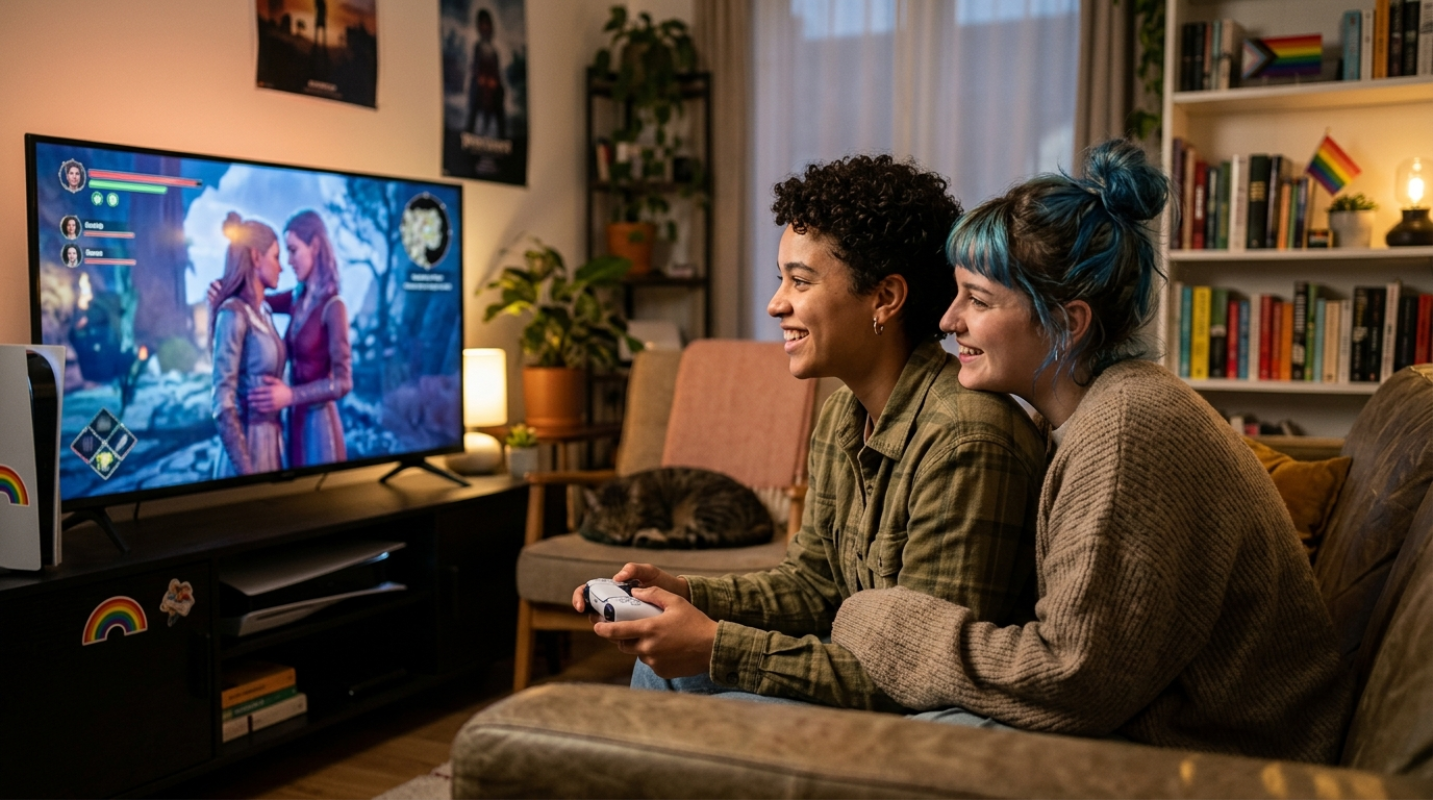
 (Image source: Google / Gemini)
 Have you ever spent three hours in a character creator just trying to make someone look like they actually belong in your skin? Or maybe you've played a game where you had to mod the files just to make a romance option feel right? For a long time, that was the standard experience for queer players. We were the hackers, the headcanoners, and the "roommates" of the gaming world. But things are changing. The shift from seeing queer characters as punchlines to seeing them as people is a big deal.
It's not just about diversity for the sake of a PR campaign. It's about the feeling you get when a character uses your pronouns without making it a whole thing. It's about seeing a story where your identity isn't the tragedy, but just a part of who you are.
Recent data shows that about 17% of active gamers identify as LGBTQ+, which is a massive 70% jump from just a few years ago. If you look at Gen Z, that number climbs even higher, hitting nearly 28%. So what does this actually mean? It means we aren't a niche audience anymore. We're a huge part of why games get made, even if the industry is still catching up.
Why Representation Matters in Gaming
Think of representation like a digital mirror. When you see yourself reflected in a game, it validates that you belong in these worlds. It’s the difference between feeling like a guest in someone else's story and feeling like the hero of your own. For many, this isn't just entertainment. It's a lifeline.
In places where life is getting harder for queer people, games become a safe harbor. About 65% of LGBTQ+ players in areas with hostile legislation say they depend on video games to get them through tough times. Have you been there? That moment where the real world feels too loud, but your favorite RPG feels like home?
It’s also about self-discovery. Roughly 36% of queer gamers say that playing these games helped them understand their own orientation or gender identity. When a game gives you the space to experiment with names, pronouns, or romances, it's giving you a low-stakes environment to figure out who you are. That’s a powerful thing for a piece of software to do.
The Evolution of LGBTQ Video Game Characters
We’ve come a long way from the days of "coded" characters. You remember them: the villains who were a little too flamboyant or the sidekicks whose "best friends" were never quite explained. For years, developers hid queerness in the subtext to avoid controversy. But today, narrative depth has replaced those old token gestures.
We’re seeing a shift toward agency. Instead of being told who your character is, modern games let you define your own journey. Look at how Baldur’s Gate 3 handled things. It didn't just include queer options: it made the entire world gender-blind in a way that felt natural. You could be whoever you wanted, and the world reacted to your choices, not your labels.
But this progress isn't happening in a vacuum. There’s a "scrutiny tax" now. Any game that dares to be inclusive often faces a wave of review bombing or coordinated harassment. We saw this with the launch of Dragon Age: The Veilguard, where anti-diversity campaigns targeted the game before it even hit shelves.¹ This backlash, often aimed at firms like Sweet Baby Inc., has made some big studios nervous, even though the majority of players don’t actually mind representation.²,³
Icons That Redefined the Queer Experience
When we talk about characters that changed everything, Ellie from The Last of Us is usually at the top of the list. She wasn't just a "gay character." She was a complex, flawed, and deeply human protagonist whose sexuality was just one part of her survival story. Seeing a massive AAA franchise put a lesbian woman front and center was a turning point.
Then there’s Dragon Age: The Veilguard. It became a major milestone for trans and non-binary representation by letting players select pronouns and featuring a fully pansexual companion roster.⁶ Characters like Taash didn't just exist as background noise: they were central to the experience. It allowed players to see their identities treated with respect in a high-fantasy setting.⁷
Indie games are also doing heavy lifting here. Take Goodbye Volcano High, which features a non-binary protagonist named Fang. It’s a bittersweet story about the end of the world, but it resonates because it captures that specific Gen Z queer anxiety. These characters feel real because they are often written by queer developers who know exactly what it’s like to handle these spaces.
Top Recommendations for Queer Players
If you're looking for games that get it right, the "cozy game" genre has become a massive haven. These games offer a break from the toxicity often found in online shooters.
• Dragon Age: The Veilguard - This is a gold standard for character creation. The ability to choose pronouns and the pansexual romance options make it feel like a world where everyone belongs.⁶
• Hades II - Melinoë is a bisexual lead, and the game treats the diverse sexualities of the Greek pantheon as a natural, casual part of the world.⁴,⁸
• Life is Strange: Double Exposure - This game is notable for including asexual representation through the character Diamond. Asexual characters are still incredibly rare in gaming, so seeing this was a huge win for that community.
• Stardew Valley - The ultimate "playersexual" game. It doesn't matter who you are: you can build a life and a family with whoever catches your eye.
• Tavern Talk - A 2024 indie gem that centers queer joy and complex identities rather than relying on the same old trauma tropes we’ve seen a million times.
Where Do We Go From Here?
The future of queer visibility in gaming is at a bit of a crossroads. On one hand, the demand is higher than ever. LGBTQ+ players are 4 to 5 times more likely to buy a game if it features a queer main character. That is massive economic power that the industry can't ignore. On the other hand, less than 2% of games on major consoles are currently tagged with LGBTQ+ content. There’s a huge gap between what we want and what we’re getting.
Big AAA studios are often risk-averse. They see the "anti-woke" movements and get cold feet. But the numbers don't lie. Most players, queer or not, just want good stories. About 70% of non-LGBTQ+ players say that queer representation doesn't negatively impact their decision to buy a game. The "risk" is often more of a ghost story than a reality.
As we move forward, the goal isn't just to have more queer characters. It's to have better ones. We want characters who get to be happy, characters who get to be heroes, and characters who are allowed to be as messy and complicated as anyone else. Queer players aren't a niche audience anymore. We’re a key part of the gaming ecosystem, and we're not going anywhere.
Sources:
1. Dragon Age: The Veilguard reviews and AI summary
https://www.smashjt.com/post/i-asked-a-i-to-summarize-dragon-age-the-veilguard-reviews-and
2. Sweet Baby Inc Detected: What actually happened
https://www.theshortcut.com/p/sweet-baby-inc-detected-what-actually-happened
3. Sweet Baby Inc and the new Gamergate
https://www.cbc.ca/radio/thecurrent/sweet-baby-inc-gamergate-1.7149888
4. Hades 2 Queerness Discussion
https://www.reddit.com/r/HadesTheGame/comments/1dbudht/i_thought_h2_wasnt_as_queer_as_h1_but/
5. Dragon Age: The Veilguard Queer Representation
https://www.thegamer.com/dragon-age-the-veilguard-queer-lgbt-tassh-non-binary/